Category: Mining | Geomembrane Specification | Containment Engineering
Lithium brine evaporation ponds are among the most demanding containment environments a geomembrane will ever face. Vast surface areas, highly concentrated corrosive brines, intense UV exposure, extreme temperature swings, and remote installation conditions — all combine to stress-test every aspect of a liner system’s performance.
For civil engineers, installers, fabricators, and project owners specifying containment solutions for lithium mining operations, the stakes are high. A geomembrane failure in this environment doesn’t just mean a repair job — it means lost lithium product, potential groundwater contamination, regulatory exposure, and significant project downtime.
This guide breaks down exactly what’s required of a geomembrane in a lithium brine application, how common materials measure up against those requirements, what performance features should be on every specifier’s checklist, and how E Squared’s Flex Liner LLDPE-R product line gives engineers the right tool for every layer of a mining containment system.
Understanding the Containment Challenge: What Makes Lithium Brine Ponds Uniquely Demanding
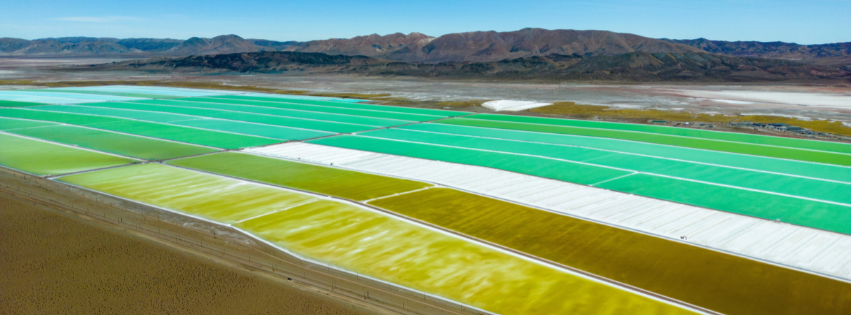
In brine-based lithium extraction — the dominant production method in the “Lithium Triangle” of Chile, Argentina, and Bolivia — lithium-rich subsurface brines are pumped to the surface and distributed across a series of large, shallow evaporation ponds. Solar evaporation progressively concentrates the lithium content over a period of months until it can be further processed into battery-grade lithium carbonate or lithium hydroxide.
These ponds can span hundreds of acres and must maintain containment integrity under conditions that would challenge even well-specified liner systems:
- Highly corrosive contents: Lithium brines are saturated with chloride salts and other minerals that aggressively attack materials with poor chemical resistance.
- Extreme UV exposure: Desert siting means constant, high-intensity solar radiation over the full operational lifetime of the liner — a critical factor in material selection.
- Temperature extremes: High-altitude mining locations experience intense daytime heat and sub-freezing nighttime temperatures — thermal cycling that can degrade brittle materials rapidly.
- Complex subgrades: Salt flat terrain is rarely uniform. Irregular, shifting ground requires liners that can conform and flex without stress cracking.
- Large-scale installation logistics: Remote locations make field seaming labor-intensive and costly. Materials that support factory prefabrication of large panels deliver significant project savings.
The geomembrane specified for this environment must perform on all of these fronts simultaneously — for the full operational life of the pond.
The Three Non-Negotiable Functions of a Lithium Pond Liner
Whatever material is selected, the liner system must reliably deliver three core functions:
- Seepage Prevention: An impermeable barrier that stops lithium brine from migrating into the subsoil — protecting product recovery rates and operational economics.
- Groundwater Protection: Containment of highly saline and potentially toxic byproducts, keeping them out of the local water table and supporting environmental compliance.
- Evaporation Control: By eliminating downward moisture loss through the soil, the liner ensures the evaporation process runs at a predictable, controlled rate — keeping concentration timelines on track.
A liner that underperforms in any one of these areas compromises the entire extraction operation. This is not a context where “good enough” is acceptable.
How Common Geomembrane Materials Perform in Lithium Brine Applications
Modern lithium mining operations have moved decisively away from compacted clay liners toward advanced geosynthetics — materials that offer superior performance at up to 50% lower installation cost. Here is how the primary options compare when evaluated against the specific demands of lithium brine containment:
High-Density Polyethylene (HDPE)
HDPE has historically been the industry default, offering excellent chemical resistance to corrosive salts, strong tensile performance, and proven UV stability. However, its rigidity is a known liability in lithium pond applications. Sites with uneven subgrades, subsurface movement, or thermal cycling create stress concentration points that can lead to stress cracking — a failure mode that is difficult to detect and expensive to remediate at scale.
Polyvinyl Chloride (PVC)
PVC’s flexibility and “lay-flat” characteristics allow it to conform closely to irregular subgrades, reducing the risk of lateral migration if a localized leak develops. It handles complex pond geometries well, but long-term UV stability in high-altitude desert conditions can be a concern in standard PVC formulations.
Linear Low-Density Polyethylene (LLDPE)
LLDPE’s superior elongation and flexibility over HDPE make it better suited to sites with ground movement or subgrade variability. Its ability to conform to the substrate without stress cracking is a meaningful advantage in lithium pond applications. Unreinforced LLDPE, however, can be vulnerable to puncture and tear during installation and under sustained hydrostatic loading.
String-Reinforced LLDPE (LLDPE-R)
Reinforced LLDPE composites address the primary limitation of standard LLDPE by incorporating a string reinforcement matrix that dramatically increases puncture resistance, tear strength, and dimensional stability — while retaining the flexibility and conformability that make LLDPE well-suited to demanding terrain. For lithium brine applications, LLDPE-R represents the best balance of chemical resistance, mechanical performance, installation efficiency, and long-term durability. The key specification decision, as discussed below, is which LLDPE formulation is right for each layer and application within the containment system.
Geomembrane Performance Features: What Belongs on Your Specification Checklist
Beyond base material selection, the following features and configurations should be evaluated for any lithium brine containment project:
- UV Resistance and OIT Rating: For exposed pond surfaces, the antioxidant package in the LLDPE formulation is critical. Oxidative Induction Time (OIT) — measured per ASTM D8117 — is the key indicator of a liner’s resistance to oxidative degradation over time. Specifiers should require documented OIT performance and verify warranty coverage for fully exposed applications.
- Chemical Resistance Verification: The liner must be rated for resistance to the specific brine chemistry of the site. Request documented chemical resistance data — including hydrocarbon resistance where applicable — from the manufacturer’s chemical resistance chart.
- Thermal Stability Across the Full Operating Range: Confirm performance at both maximum daytime operating temperatures and minimum nighttime temperatures at site elevation. The E Squared Flex Liner LLDPE-R line is rated to -40°F for low temperature bend and impact, and a minimum static use temperature of -70°F — critical for high-altitude Andean mining sites.
- Underlayment Compatibility: In rocky or abrasive subgrade conditions, a nonwoven geotextile underlayment should be specified to cushion the primary liner from puncture under hydrostatic pressure.
- Seam Integrity and Fabrication Approach: Factory prefabrication into large panels significantly reduces field seams — the most common failure point in any liner installation. The Flex Liner LLDPE-R supports thermal sealing with factory seams that are 100% visually inspected and destructively tested for quality compliance.
- Surface Finish for Slope Stability: For sloped pond sections, a dimple textured finish (7 mil asperity height) provides improved traction and reduces the risk of liner movement under gravity loading.
- Compliance and Certification: Confirm the material meets GRI-GM25, is manufactured in the USA, and carries Buy America/Build America (BABA) certification where required by project funding requirements.
Choosing the Right E Squared Flex Liner for Your Lithium Mining Application
E Squared’s Flex Liner LLDPE-R line gives specifiers two distinct products built on the same proven string-reinforced fabric platform — differentiated by their LLDPE formulation to match the specific exposure conditions of each layer in the containment system. Both products share the same polyester base fabric (2.6 oz/yd², 9×9 weft-inserted 1000-denier reinforcement), physical construction, thickness options, and GRI-GM25 compliance. The difference is in what the LLDPE is engineered to withstand.
Flex Liner LLDPE-R OIT — For Exposed Pond Surfaces
The Flex Liner LLDPE-R OIT is the specification of choice for the primary liner in lithium brine evaporation ponds — anywhere the geomembrane will be in direct, long-term contact with UV radiation, atmospheric oxygen, and corrosive brine chemistry.
Its LLDPE formulation incorporates an enhanced antioxidant package specifically engineered for exposed applications, delivering a Standard OIT of 100 minutes (with 50 minutes retained after oven aging at 85°C for 90 days, per ASTM D8117). This formulation is backed by a 20-year exposed application warranty — covering the liner against UV degradation and manufacturing defects for the operational life of the pond.
The LLDPE-R OIT is also engineered for hydrocarbon resistance, making it well-suited to containment applications where brine chemistry includes hydrocarbon compounds. Consult E Squared’s chemical resistance chart to verify compatibility with your specific site chemistry.
Key performance data (consistent across all thickness options):
- Tear Resistance: 70–100 lbs MD and TD, depending on thickness
- Breaking Strength: 220–290 lbs MD and TD, depending on thickness
- Puncture Resistance: 75–100 lbs flat tip, depending on thickness
- Elongation: 22.0%
- Low Temperature Bend Test: -40°F (ASTM D2136)
- Low Temperature Impact Test: -40°F (ASTM D2137)
- Minimum Static Use Temperature: -70°F
- Maximum Static Use Temperature: 180°F intermittent
- Standard OIT: 100 min (50 min retained after oven aging at 85°C/90 days) per ASTM D8117
- Toxicity: Non-toxic — Microtox, Daphnia magna 48-hr, Pimephales promelas 96-hr
- Chlorinated Water Resistance: Passes GRI GM24; retains 80%+ tensile properties after 90-day immersion at 10 and 50 ppm
- Compliance: GRI-GM25 | Made in USA | BABA Certified
- Warranty: 20 years — exposed applications
Available in 30, 36, 45, and 60 mil. Offered in smooth or dimple textured finish. Standard width 120 inches.
Flex Liner LLDPE-R STD — For Buried Secondary Containment Layers
Where the containment system includes a buried secondary liner — installed beneath a primary liner or backfilled with soil or aggregate — the Flex Liner LLDPE-R STD is the appropriate specification. Engineered for applications with no direct UV exposure, the STD formulation is backed by a 20-year buried application warranty, with UV exposure expected to be less than five years.
Its physical properties are essentially identical to the OIT grade — same reinforcement architecture, same thickness options, same strength, flexibility, and low-temperature performance. The distinction is in the LLDPE formulation, which is optimized for buried service rather than long-term UV and oxidative exposure.
This makes the STD grade a cost-effective choice for secondary containment layers, anchor trenches, and any liner sections that will be covered and protected from atmospheric exposure following installation.
Available in 30, 36, 45, and 60 mil. Offered in smooth or dimple textured finish. Standard width 120 inches.
Specifying Both Products Together
For a complete lithium brine containment system, the two Flex Liner grades work in combination:
- Primary pond liner (exposed): Flex Liner LLDPE-R OIT — 20-year exposed warranty, enhanced UV and oxidative resistance, hydrocarbon-resistant formulation.
- Secondary or buried liner: Flex Liner LLDPE-R STD — 20-year buried warranty, identical mechanical performance, optimized for covered service.
This approach gives project owners full warranty coverage across the entire containment system while ensuring each layer is specified with the right formulation for its actual exposure conditions — avoiding the cost of over-specifying buried layers and the risk of under-specifying exposed ones.
Working with E Squared on Your Lithium Mining Containment Project
E Squared’s geomembrane team works directly with civil engineers, fabricators, installers, and project owners at every stage of a containment project — from early specification development through fabrication and installation support. Drop-in specifications and data sheets for both Flex Liner LLDPE-R grades are available through the E Squared Resources Center to support your project documentation.
For lithium mining applications, our team can help you determine the right thickness, finish, and product grade for each layer of your containment system, and can provide chemical resistance data specific to your site’s brine chemistry.
Connect with an E Squared geomembrane expert at e2geomembranes.com/contact, or explore the full LLDPE-R product page for technical specifications and downloadable resources.