Track failures for freight and passenger trains rarely start with the rails. Rather, the first cause is often underneath them where the subgrades got wet, softened, and stopped carrying loads the way they were designed. Or ongoing erosion gained the upper hand. The same can hold true for trolley cars and trams.
Water is the common denominator and enemy for most problems with rail substructure. Water needs to be channeled or diverted away from the rail substructure. Embankment saturation has to survive by deflecting water. Frost heaves, differential settlement, mud pumping, and ballast fouling often occur. Applying the correct geomembrane is one of the simplest ways to take water out of the equation.
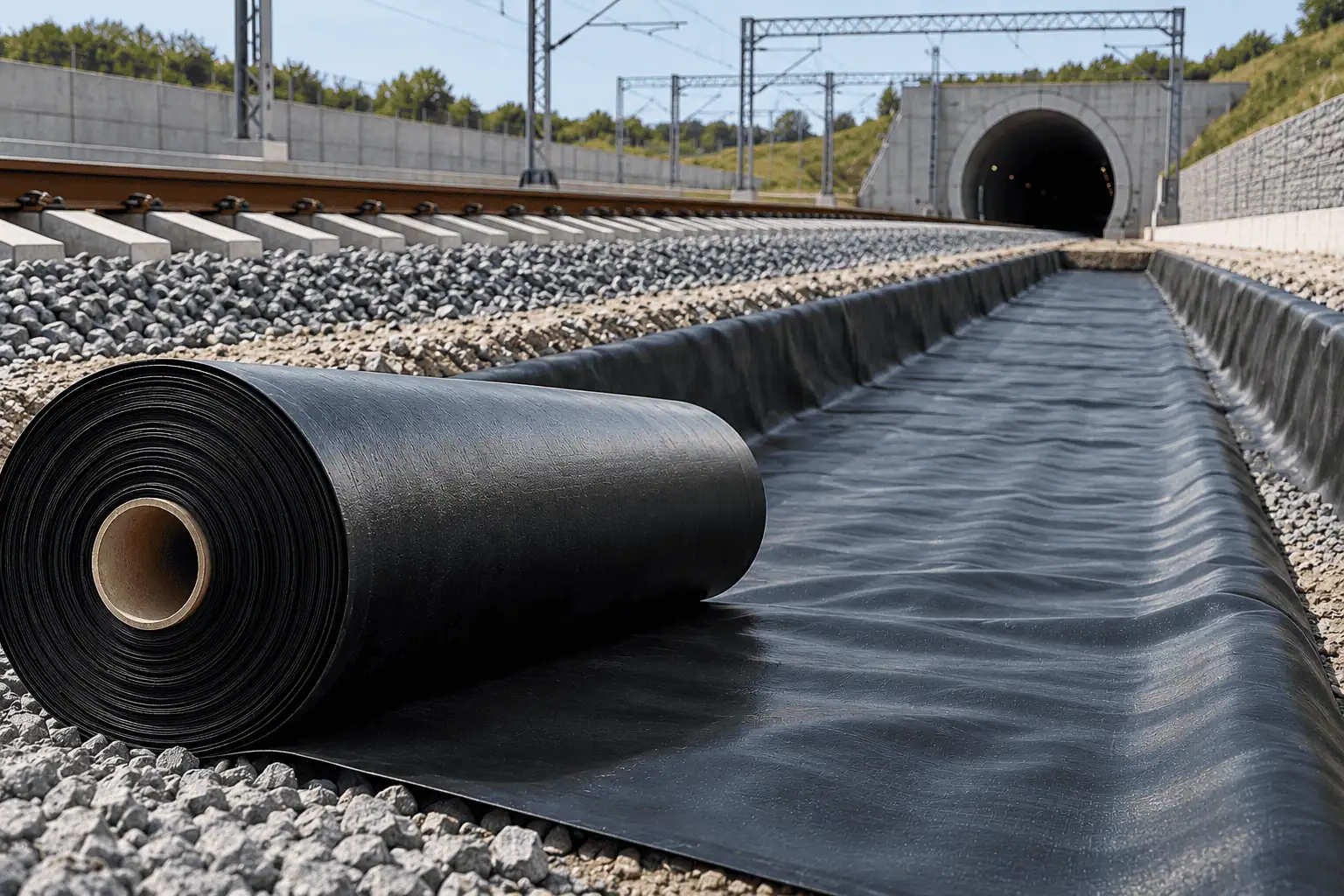
When geomembrane is applied as an impermeable synthetic barrier placed within rail structures, it isolates the subgrade from groundwater and surface infiltration, and better preserves load-bearing capacity.
Here’s where geomembranes are best used for rail projects.
- Subgrade Waterproofing and Protection
The subgrade is the foundation of the entire track structure, and its strength is directly tied to the stability of its moisture content. When subgrades are pushed past their optimum moisture, its shear strength drops fast.
Controlling moisture content. A geomembrane installed on top of the prepared subgrade, beneath the track structure above it, stops rainwater and surface runoff from reaching the soil. The subgrade stays near its compacted design moisture, which means it keeps performing at the strength the geotechnical report assumed.
Protecting moisture-sensitive soils. Some alignments cross ground that reacts badly to water, such as caliche, swelling clays that heave, gypseous soils that dissolve, and collapsible loess that loses structure when saturated. In conditions such as these a barrier isn’t an upgrade, it’s the thing standing between the design and recurring maintenance problems.
Preventing mud pumping. Under repeated axle loading, fine particles from a saturated subgrade migrate upward into the ballast. The ballast fouls, drainage stops working, and the track settles unevenly. Sealing the subgrade interrupts that migration path before it starts.
Math for maintenance matters here. Track geometry work — surfacing, lining, ballast cleaning, undercutting — is expensive, disruptive, and recurring. A barrier installed one time during construction addresses the need and expense of ongoing, repeated maintenance work.
- Railyard Environmental Containment and Water Diversion
Railyards concentrate activities that create environmental exposure. Things like locomotive servicing, refueling, maintenance shops, wash racks, and transloading dramatically impact the moisture levels.
Spill mitigation. Geomembranes form impermeable containment basins beneath and around these railyard operations. They capture spills and leaks before they reach soil and groundwater. Servicing tracks, fueling pads, and maintenance aprons are all common applications for geomembrane lining.
Chemical resistance. Fuel and lubricant exposure can be constant, so choice matters in what resin is preferred. HDPE and LLDPE are common baseline choices for general containment, but sustained diesel or hydrocarbon exposure often calls for a more chemically resistant polymer such as PVC, EPDM, or a reinforced, coated fabric, depending upon the specific chemistry, concentration, and temperature involved. You should specify against the actual chemistry on site, not just the thickness or a generic “geomembrane” callout.
The regulatory driver is straightforward: containment that meets EPA and state requirements is far cheaper than remediation after a release.
- Railroad Tunnel Waterproofing
In cut-and-cover and bored railway tunnels, groundwater is a permanent condition, not an occasional event.
Geomembranes serve as seepage barriers, often in a double-membrane configuration with a drainage layer between, diverting groundwater around the structure and to a controlled collection system. The result is a dry tunnel interior that protects the concrete lining from degradation, protects embedded steel and signaling equipment from corrosion, and keeps water out of the track bed.
Because access for repairs is limited once a tunnel is in service, two things deserve disproportionate attention during design: waterproofing detailing at joints, penetrations, and construction interfaces, and the quality of the field seaming itself. Seam integrity, typically verified through wedge welding or extrusion welding with subsequent air-pressure or vacuum-box testing, is often the actual point of failure in a containment system, not the base material. A well-specified membrane installed with poor seam QC will still leak.
- Specialized Rail Applications
Dielectric protection. In electrified systems, stray traction current might migrate into station platforms and adjacent structures. Electrical isolation beneath platforms is typically achieved with purpose-built dielectric barrier products like insulating mats or coatings formulated for high electrical resistivity, rather than using general waterproofing geomembranes discussed elsewhere in this article. Dielectric characteristics are a distinct product category, and it’s worth specifying separately as a passenger-safety and corrosion-control measure rather than folding it into standard liner specs.
Direct ballast contact. Certain heavy-duty membranes are manufactured with a sanded or textured upper surface designed to improve interface friction against coarse ballast and resist slippage on grade, which matters on any alignment that isn’t flat. That said, this texture is a friction and durability enhancement, not a substitute for a cushion layer. In practice, even textured, heavy-duty membranes are typically still installed with a protective nonwoven geotextile above them in ballasted track — see the system note below.
Technical Benefits at a Glance
| Application Area | Primary Mechanism | Measurable Benefit |
|---|---|---|
| Subgrade and embankments | Blocks capillary rise and surface infiltration | Reduces frost heave, soil softening, and differential settlement |
| Railyards | Secondary containment resistant to hydrocarbons and chemicals | Environmental compliance; prevents soil and groundwater contamination |
| Tunnels | Diverts hydrostatic pressure and seepage away from the structure | Extends lining service life; prevents track flooding |
Geomembrane Is Part of a System
One major, noteworthy point: in rail work a geomembrane almost never performs alone.
Ballast is angular, heavy, and repeatedly loaded — and construction equipment tracking over an exposed liner is its own hazard. Standard practice is to sandwich the membrane between nonwoven geotextile cushion layers: one below to protect against subgrade stones and irregularities, and one above to protect against ballast and installation traffic. This applies even to the sanded or textured heavy-duty membranes described above. Texture improves friction and abrasion resistance, but angular ballast under cyclic axle loading remains one of the most aggressive puncture environments a membrane will see. And puncture resistance is typically verified against standards such as ASTM D4833 (puncture) and D5199 (thickness) during specification. Drainage geo-composites are frequently added to move intercepted water to a collection point rather than letting it pond on the barrier.
Specifying the membrane without specifying the protection layers or without specifying seam QC and installation staging (including UV exposure limits for any membrane left temporarily uncovered) is one of the more common ways a well-designed system underperforms in the field.
Talk to Us About Your Alignment
Subgrade conditions, groundwater levels, traffic tonnage, and chemical exposure all change what the right liner looks like. E Squared works with rail engineers, contractors, and infrastructure owners, as well as procurement, to match material, thickness, and protection layers to the actual conditions on the project.